Home Blog

Tinubu’s political achievements cannot be written out of history – PEBEC boss

0

Princess Zahrah Audu, Director-General, Presidential Enabling Business Environment Council (PEBEC), says President Bola Tinubu’s political achievements cannot be written out of Nigeria’s history.

Audu said this in a statement on Saturday, assessing Tinubu’s political career and controversies surrounding his biography.

“His certificates may be questioned. His biography may be contested. But his political accomplishments cannot simply be written out of history,” she said.

Audu said Nigerians had the right to scrutinise Tinubu’s biography but should distinguish between allegations, disputed facts and established facts.

She cited the controversy over Tinubu’s education, saying Chicago State University confirmed during 2023 litigation that he attended the institution and graduated in 1979.

According to her, the controversy concerned the provenance and authenticity of a particular diploma copy submitted to Nigerian electoral authorities.

Audu said political achievements should neither be used to dismiss legitimate questions nor disputed issues be exaggerated beyond available evidence.

She said political leadership also produced evidence through decisions, institutions, coalitions, reforms, electoral victories and measurable outcomes.

Audu said that Tinubu’s political career spanned the Senate, Lagos governorship, opposition politics, party organisation and ultimately the presidency.

“Whatever one’s political opinion of that journey, it is difficult to describe it as accidental,” she said.

She said Tinubu’s political trajectory reflected decades of alliances, negotiations, institution-building, political calculation and electoral contests.

Audu said even if critics’ harshest assumptions about Tinubu’s educational credentials were accepted, they would not erase his political career and achievements.

She, however, acknowledged concerns over inflation, food insecurity and the cost of living following reforms including fuel-subsidy removal and changes to the foreign-exchange regime.

She said the International Monetary Fund had recognised improvements in macroeconomic stability while also highlighting continuing challenges, including poverty and food insecurity.

Audu compared Tinubu’s political journey with those of Nelson Mandela and Jerry Rawlings, but cautioned that their historical circumstances were fundamentally different.

She said the comparison was based on the broader principle that political legacies should be assessed from the entirety of leaders’ careers.

“History is not acquittal, history is accumulation,” Audu said.

She said the administration should equally be criticised where evidence warranted, while its achievements should receive evidence-based assessment and recognition. (NAN)

Analysts urge line-by-line scrutiny as 2026 budget implementation begins

0

Fiscal-governance analysts and civil society organisations have called for sustained, line-by-line scrutiny of the 2026 federal budget, warning that its size and structure will require close monitoring throughout the year.

The ₦68.32 trillion budget, signed into law in April and now under implementation, is the largest in Nigeria’s history. Analysts say its scale alone makes rigorous oversight a public necessity rather than an option.

Their concern, they stress, is not with the headline figures but with how those figures were arrived at — and whether every allocation in the document reflects a genuine national priority.

Nigeria’s budgeting process has long drawn criticism for the gap between what is appropriated and what is ultimately delivered. Successive budgets have been marked by allocations that swell during passage, projects that appear without clear justification, and spending that is difficult for citizens to trace once the fiscal year begins.

Transparency advocates warn that this pattern erodes public trust and weakens the link between government spending and development outcomes. Funds can be voted, they note, without ever reaching the classrooms, clinics, roads and communities they were intended for.

They add that in a period of economic strain, when many households are under pressure, the demand that every naira of public money deliver measurable value carries greater weight than ever.

The civic-technology group BudgIT, in its analysis of the 2026 budget, cautioned that approved budgets in Nigeria do not automatically translate into performance, partly because the release of funds is often opaque and difficult to track. It urged lawmakers, the media and citizens to move beyond reading allocations to monitoring actual releases and project delivery.

For its part, the Federal Government has pledged a renewed emphasis on discipline. Presenting the budget to a joint session of the National Assembly, President Bola Tinubu said the era of overlapping budgets, abandoned projects and endless rollovers must end, and that 2026 would be a year of stronger execution.

“The greatest budget is not the one we announce. It is the one we deliver,” the President said.

Analysts say that commitment will be judged not by speeches but by evidence — by whether funds are released on schedule, whether projects are completed, and whether the priorities on paper match the needs on the ground.

They point to several tools already available to the public. The full budget details are published by the Budget Office of the Federation, quarterly implementation reports are required by law, and platforms exist to track government spending at the project level. What is often missing, they say, is the sustained attention needed to put those tools to use.

Civil society groups have also called on the National Assembly to explain the basis for changes made to the budget during its passage, arguing that transparency about such adjustments is essential to accountability.

As implementation gathers pace, observers say the questions worth asking are straightforward: what was budgeted, why, and whether the spending can be justified when examined closely.

Those questions, they add, deserve answers — line by line.

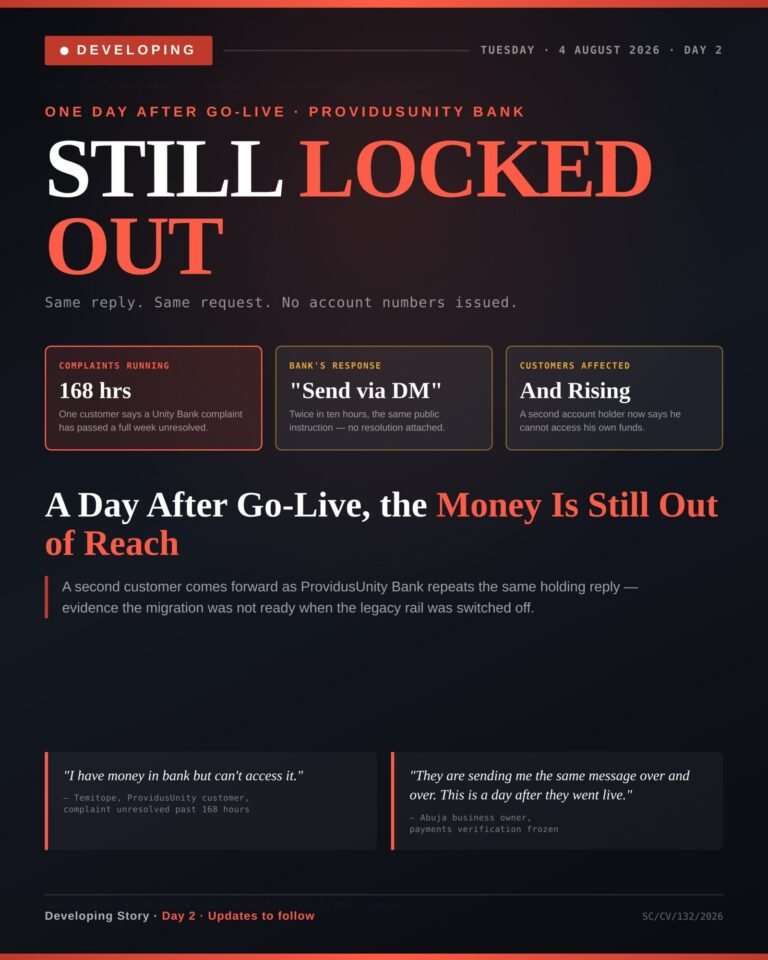
DEVELOPING: A Day after Go-Live, ProvidusUnity Customers Still Locked Out

0

Tuesday, August 4, 2026

More than 24 hours after ProvidusUnity Bank’s account migration was due to take effect, affected customers say they still have no new account numbers, no written confirmation, and no resolution — only repeated instructions to submit their details again.

An Abuja-based business owner who operates a registered writing and consultancy enterprise, and who asked not to be named, told this publication that a bank customer care agent assured them last Friday that a new account number would arrive by Monday. It did not.

“It is Monday. I have received nothing — no email, no SMS, no new number. Meanwhile I have been told the old one is being switched off,” the customer said on go-live day.

By Tuesday, the position had not improved. After the customer raised the matter publicly on X, the bank’s verified account responded within hours, asking them to send details privately. Roughly ten hours later, following a second escalation, the bank replied again — with essentially the same request.

“Thank you for contacting ProvidusUnityBank. We are sorry to learn of this experience. Please send your account number to us via DM to enable us review further checks,” the bank wrote in a public reply signed by an agent.

“They are sending me the same message over and over,” the customer said. “This is a day after they went live. If they cannot resolve it now, when were they ever going to be ready?”

What began as one customer’s problem now appears to be broader. In the same public thread, another account holder, described being unable to reach his own funds.

“I’m so frustrated with the bank. I have money in bank but can’t access it,” he wrote, adding that ProvidusUnity had been unable to resolve the issue because it could not resolve legacy Unity Bank account problems, and that a complaint lodged with Unity Bank itself had run past 168 hours — a full week — without resolution.

That detail matters. It suggests the unresolved cases predate the go-live date and are not simply teething problems from a single switchover morning.

In banking terms, this is not a rebrand but a full account renumbering exercise. Each migrated account must be onboarded, BVN-linked and KYC-cleared across the Nigeria Inter-Bank Settlement System and every partner platform before its legacy counterpart is decommissioned. Until that clearance propagates across all rails — bank apps, POS terminals, USSD channels, third-party fintechs and international settlement partners — the new number cannot reliably receive inbound funds.

When one such new number was checked on a major fintech platform ahead of the switch, it returned unreachable under both the Unity Bank Plc and Providus Bank Plc listings, with the decline code: “Account unavailable — Recipient’s KYC verification incomplete.”

The result is a blind settlement window: the old rail dark, the new rail not yet live. On the evidence of the past 48 hours, that window has not closed.

For the Abuja business owner, the consequence is a frozen international payments verification with Payoneer, the platform Nigerian freelancers and exporters use to receive foreign earnings. The process requires a verified local settlement account. With the old number closing and no new one issued, the application sits pending, subject to a verification deadline the customer cannot control.

Nigeria has already demonstrated the safer method. When Access Bank completed its merger with Diamond Bank — court-sanctioned March 19, 2019 and finalised April 1, 2019 — customers retained their existing account numbers throughout. Both brands pointed to the same underlying ledger. No renumbering. No blind window. No stranded verifications.

ProvidusUnity Bank should state publicly how many legacy accounts remain unmigrated, confirm whether old numbers remain operational in the interim, and provide written documentation customers can present to third-party platforms holding verifications in limbo.

The bank has repeatedly promised a seamless transition. Two days past go-live, with customers unable to access funds and complaints running beyond a week, the word is doing more work than the system behind it.

This is a developing story. ProvidusUnity Bank’s public responses are reflected above; the bank has been asked for a substantive comment on the scale of unresolved migrations. Updates will follow.


Four Years to 2030: New Report Warns Africa Is Falling Behind Its Own Deadline

0

Africa has less than five years left to hit the development targets it set for itself, and a new joint report says the continent is moving too slowly to make it.

The 2026 Africa Sustainable Development Report was unveiled in New York on the sidelines of the UN’s High-Level Political Forum, produced jointly by the African Union Commission, the UN Economic Commission for Africa, the African Development Bank and the UN Development Programme. It remains the only publication that tracks Africa’s progress on both the global Sustainable Development Goals and the continent’s own long-term blueprint, Agenda 2063, side by side treating them, as the authors insist, not as two separate races but as one shared course.

This year’s edition narrows its focus to five goals under review clean water and sanitation, affordable energy, industry and infrastructure, sustainable cities, and partnerships for the goals areas the report identifies as the load-bearing walls of Africa’s broader transformation. The verdict on all five: real gains, but not nearly enough of them, and not fast enough.

Financing shortfalls, climate shocks, mounting debt and thin institutional capacity are named as the chief drags on delivery, with the report calling for bigger investment, stronger systems and far more coordinated action across governments if the 2030 finish line is to mean anything.

Amina Mohammed, the UN Deputy Secretary-General, put the diagnosis bluntly: what separates good plans from real change on the ground is fragmented delivery, thin financing and weak institutions and she credited regional cooperation as one of the few genuine accelerators available to African states.

Ambassador Selma Malika Haddadi, Deputy Chairperson of the African Union Commission, framed the two development agendas as a single obligation rather than parallel paperwork, arguing that Africa’s progress will ultimately be judged not by the strategies it writes but by the lives those strategies actually change and that the era of planning has given way to an era demanding delivery.

ECA’s Executive Secretary, Claver Gatete, described the continent as standing at a decisive juncture, with under five years left on the clock. Progress, he said, is achievable, but only through coordinated, transformative action stronger institutions, mobilised financing and smarter use of innovation turning today’s constraints into tomorrow’s openings.

For Ahunna Eziakonwa, the UN Assistant-Secretary-General who directs UNDP’s Africa bureau, the arithmetic is simple even if the politics are not: time may be short, but opportunity remains open, and closing the SDG gap will require real investment in Africa’s people, ideas and natural wealth choices that will shape the continent for generations beyond this decade.

Other officials pointed to where that investment must land first. Al Hamndou Dorsouma, who manages the African Development Bank’s climate change and green growth portfolio, named water, energy, infrastructure, liveable cities and partnerships as the foundations requiring urgent reinforcement, insisting that incremental change no longer suffices only scaled-up investment paired with genuine regional cooperation will do.

The report’s findings are already shaping conversations to come, feeding directly into priorities on expanding clean energy access, hardening infrastructure, deepening regional integration, and building stronger data systems to track it all.

Beyond the diagnosis, the report’s authors are positioning it as a working tool meant to sharpen decisions for governments, development partners, researchers and civil society alike, rather than gather dust as another stocktaking exercise.

The message underlying every official’s remarks was the same, stated with unusual bluntness for a joint UN-AU release: the strategies exist. What Africa is short of, with the clock now audibly ticking toward 2030, is the speed and coordination to execute them.

West Africa’s growth outlook remains positive despite global uncertainties — EBID

0

West Africa is expected to remain one of Africa’s fastest-growing regions despite increasing global economic uncertainties, according to the latest economic outlook released by the ECOWAS Bank for Investment and Development (EBID).

The regional lender said the sub-region recorded strong economic performance in 2025 but warned that external shocks, volatile commodity prices and global trade tensions could moderate growth in 2026 and 2027.

The report noted that improved macroeconomic management, expanding regional trade and ongoing infrastructure investments continue to support economic activity across ECOWAS member states.

However, it identified inflation, public debt pressures, climate-related risks and geopolitical instability as major threats capable of slowing the region’s economic momentum.

EBID stressed that accelerating regional integration, deepening intra-African trade and improving the business environment would be essential to sustaining growth and attracting private investment.

The Bank also called for increased financing for transport, energy, agriculture and digital infrastructure to strengthen productivity and enhance competitiveness.

It said implementation of the African Continental Free Trade Area (AfCFTA) offers significant opportunities for West African economies to diversify exports, strengthen regional value chains and create jobs.

The report urged governments to pursue prudent fiscal policies while expanding investment in productive sectors capable of driving long-term economic transformation.

PEBEC Facilitates Timely Passport Renewal Following Citizen’s Complaint

0

Lucy Ogalue

The Presidential Enabling Business Environment Council (PEBEC) has received commendation following its intervention in resolving a delayed international passport renewal for a Nigerian citizen.

The citizen, who shared her experience on social media, said she had encountered prolonged delays while attempting to renew her international passport through the Nigerian Immigration Service.

According to her, she reported the matter to PEBEC, which promptly engaged the relevant authorities, leading to the successful issuance of her passport.

Expressing appreciation for the intervention, she wrote: “After reaching out to PEBEC, I received prompt attention, and my passport was successfully renewed. Yes, Nigeria works.”

The development highlights PEBEC’s role in working with Ministries, Departments and Agencies (MDAs) to address bureaucratic bottlenecks and improve public service delivery.

The council continues to collaborate with government institutions to make public services more transparent, efficient and responsive, while promoting reforms aimed at improving Nigeria’s business environment.

Observers say timely interventions in service-related complaints can help strengthen public confidence in government institutions and encourage greater accountability in service delivery.

PEBEC was established to improve Nigeria’s business environment by driving reforms and enhancing service delivery across Federal Government institutions.

ECA calls for urgent action to transform informal work into sustainable jobs for Africa’s youth

0

The United Nations Economic Commission for Africa has called for urgent and coordinated action to transform informal employment into sustainable livelihoods for millions of young people across Africa.

The call was made during a side event organised by the ECA through its Offices for Eastern and Central Africa on the sidelines of the 2026 High-level Political Forum on Sustainable Development (HLPF) in New York.

The event, themed “From Informal Work to Sustainable Livelihoods: Youth Pathways in Fragile Cities in Africa,” brought together policymakers, development partners, academics, youth representatives and United Nations agencies to examine practical strategies for addressing youth unemployment and expanding economic opportunities on the continent.

Discussions centred on tackling skills gaps, improving access to finance, promoting entrepreneurship, advancing inclusive urban development and strengthening partnerships to create sustainable employment opportunities for young Africans.

Opening the event, ECA Executive Secretary, Mr Claver Gatete, stressed the need for African countries to harmonise education systems, professional qualifications and skills certification to facilitate labour mobility across the continent.

He said aligning qualifications would enable young people to access employment opportunities beyond their national borders while supporting Africa’s broader integration agenda.

Participants also identified limited access to finance as one of the major constraints facing young entrepreneurs, noting that inadequate credit and investment continue to hinder business creation, expansion and formalisation.

They emphasised the importance of strengthening financial inclusion, entrepreneurship support programmes and business development services to help young people build sustainable enterprises and contribute more effectively to economic growth.

The forum further examined the implications of artificial intelligence (AI) and other emerging technologies on Africa’s labour market.

Participants observed that while AI offers significant opportunities to improve productivity, innovation and economic competitiveness, it also presents new challenges for employment, particularly for Africa’s rapidly growing youth population.

They stressed the need to equip young people with relevant digital and technical skills to enable them to benefit from technological transformation rather than be displaced by it.

The meeting also highlighted the importance of investing in youth as drivers of innovation, resilience and economic development, rather than viewing them solely as beneficiaries of government and development interventions.

Participants called for stronger efforts to ensure that Africa’s rapid urbanisation translates into inclusive and sustainable growth, particularly in fragile and crisis-affected cities where unemployment, displacement and climate-related challenges continue to place pressure on livelihoods.

They advocated expanded support for youth-led enterprises, increased investment in decent jobs and improved access to economic opportunities capable of delivering long-term social and economic benefits.

The event attracted broad participation from government officials, international organisations, civil society groups, academia and young people, reflecting growing global interest in policies that promote employment, entrepreneurship and sustainable livelihoods for Africa’s expanding youth population.

Nigeria, 3 African nations to launch cocoa value addition alliance in Abuja

0

By Lucy Ogalue

Nigeria, Cameroon, Côte d’Ivoire and Ghana will launch a Cocoa Value Addition Alliance in Abuja to strengthen Africa’s position in the global cocoa market.

The Minister of State for Industry, Sen. John Enoh, said this in a statement on Friday.

The four countries produce about two-thirds of the world’s cocoa and will sign the Abuja Declaration at the Cocoa Value Addition Summit 2026 on Tuesday.

The declaration commits the countries to negotiate, set standards and engage global markets through a unified regional platform.

Nigeria will also sign the Cocoa Value Addition Accord with cocoa-producing states, industry groups, researchers and development financiers.

The accord commits stakeholders to measurable targets on cocoa processing, farmer income, investment and value addition.

The summit, themed “From Bean to Brand,” is convened by the Federal Government through the Federal Ministry of Industry, Trade and Investment.

The minister of state for industry said Africa must take greater control of its cocoa value chain.

“For a hundred years, Africa has sent its cocoa to the world in sacks and received it back in wrappers, paying at both ends of the transaction.

“The distance between a bean and a brand is measured in jobs and dignity. We do not gather to lament the market; we gather to redesign our place in it,” he said.

Enoh said the alliance would help member countries expand local processing, manufacturing and branding of cocoa products.

The summit comes amid volatile global cocoa prices and new European Union traceability requirements for cocoa imports.

Participants are expected to adopt a common position on implementing the European Union Deforestation Regulation while protecting smallholder farmers from additional compliance costs.

The summit will feature financing discussions involving the Bank of Industry, NIRSAL and development finance institutions.

It will also showcase plans for Nigeria’s largest cocoa processing plant, a 70,000-metric-tonne facility in Sagamu, Ogun, expected to begin operations in 2027.

The summit forms part of the implementation of the Nigeria Industrial Policy, which prioritises agro-industrial value addition under the Tinubu administration. (NAN)

Sanitising Nigeria’s auto market via dealership registration

0

By Lucy Ogalue, News Agency of Nigeria (NAN)

For decades, Nigeria’s automotive market has operated largely in the shadows; it has been fragmented, informal and often risky for both buyers and investors.

From cases of stolen vehicles to disappearing dealers and limited access to financing, stakeholders say the absence of a structured system has long undermined growth in the sector.

Recently, however, the Federal Government unveiled the National Vehicle Dealership Registration Framework, which is being seen as a potential turning point.

At the centre of the initiative is the National Automotive Design and Development Council (NADDC), which has introduced a digital platform to formally register and track vehicle dealers nationwide.

NADDC Director-General, Joseph Osanipin, provided insights during the inauguration.

He described the framework as more than a regulatory tool.

“Today is not merely an administrative milestone; it is the day we transition from planning to practice.”

He said that the platform was designed to “modernise, sanitise and revolutionise” automotive business operations in Nigeria.

Stakeholders say that Nigeria remains one of Africa’s largest markets for used vehicles, commonly known as “Tokunbo,” with imports dominating supply.

They say the absence of reliable data on dealers and transactions has created loopholes for fraud and inefficiencies.

Osanipin acknowledged these gaps, noting that the framework would provide long-needed visibility into the sector.

“It has been long overdue for us to have full data, full details, and the identity of those that are motor dealers in Nigeria,” he said.

He cited cases where buyers unknowingly purchased stolen vehicles or were unable to trace sellers after faults emerged.

The director-general said such incidents eroded consumer confidence and discouraged formal investment in the sector.

Auto industry stakeholders say one of the strongest arguments for the new framework is its potential to enhance security.

President of the Association of Motor Dealers of Nigeria (AMDON), Prince Ajibola Adedoyin, said the initiative would help address crimes linked to vehicles.

“Most times, tracing the source of vehicles used in crimes becomes very difficult.

“With this, every car can be traced to the doorstep of the source,” he said.

Analysts say improved traceability aligns with global standards, where vehicle registration systems are integrated with law enforcement databases.

According to Sarah Benjamin, an analyst, the framework can also curb the circulation of stolen and substandard vehicles.

Beyond security, Benjamin highlighted the framework’s potential to unlock financing, an area long constrained by trust deficits.

According to the NADDC boss, financial institutions have been reluctant to support vehicle purchases due to lack of verifiable dealer identity.

“Banks will not want to finance someone they will give money to and it will disappear.

“More so, a verified dealer database will give lenders more confidence to support transactions,’’ Osanipin said.

The AMDON national president agreed to this, noting that access to credit depended largely on trust and data.

“If you do not know who you are dealing with, you cannot give credit. But with proper data, credit can be facilitated easily.

“Improved access to credit can also stimulate demand, expand dealership operations and support growth in the broader automotive value chain,’’ Adedoyin said.

On the effect of the framework on local industry and AfCFTA prospects, the NADDC director-general said the framework was expected to support Nigeria’s ambition to become a regional automotive hub under the National Automotive Industry Development Plan (2023–2033).

Osanipin described the initiative as a “vehicle” for implementing the policy roadmap.

“A roadmap is useless without a vehicle. This Registration Framework is that vehicle.

“A structured, registered and data-driven dealership network is Nigeria’s strongest currency. It will strengthen Nigeria’s position under the African Continental Free Trade Area (AfCFTA),” he said.

He noted that standardisation would be critical for Nigerian dealers to compete across African markets.

At the heart of the initiative is a digital portal developed to simplify registration, reduce paperwork and improve efficiency.

Osanipin said the system would serve as a “digital birth certificate” for vehicles sold through certified dealers.

He expressed similar optimism saying. “Nigerians on their own are going to systematically take out those that are not recognised”.

Meanwhile, experts believe this could significantly reduce grey-market activities and promote accountability.

They also point to the likelihood of “self-regulation,” where consumers increasingly favour registered dealers over informal operators.

In spite of the optimism, Mr Kelvin Owoicho, an auto industry analyst, cautioned that implementation would be key to the framework’s success.

Owoicho emphasised the need for effective enforcement, public sensitisation and inter-agency collaboration.

He reiterated that awareness campaigns would be critical in driving adoption.

“It is about sensitisation; the public needs to know the benefits of buying from registered dealers.

“Although informal operators may resist the transition, especially if compliance costs are perceived as high, the long-term benefits outweigh the challenges,” he said.

Similarly, Mr Justin Ugbede, an industry stakeholder, said the inauguration of the dealership registration framework could mark a defining moment for Nigeria’s automotive industry.

“If effectively implemented, it can improve transparency, enhance security, unlock financing and attract investment.

“More importantly, it can shift the sector from an informal, high-risk environment to a structured and globally competitive ecosystem,” he said.

As the NADDC boss said, the goal is clear: to build “an industry that is transparent, profitable and globally competitive.”

For millions of Nigerians who rely on vehicles daily, a digital database of dealer identities and vehicle transactions, as well as other provisions of the initiative, could not come soon enough.(NANFeatures)

Institute trains NYSC members on leadership, digital skills

0

By Lucy Ogalue

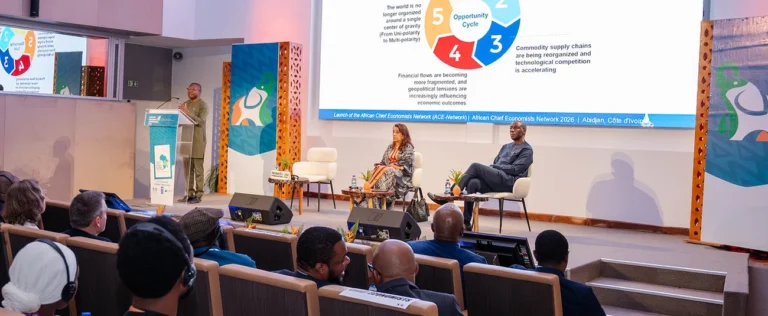
The Public Service Institute of Nigeria (PSIN) has commenced an intensive five-day training programme for National Youth Service Corps members serving at the institute.

The Administrator and Chief Executive Officer of PSIN, Imeh Okon, said this in a statement issued on Wednesday in Abuja.

Okon said the initiative formed part of the institute’s commitment to youth empowerment, leadership development and promoting excellence within Nigeria’s public service sector.

According to her, the programme is designed to equip corps members with practical knowledge, professional exposure and workplace competencies required in today’s evolving professional environment.

She said the training covered key areas including public service administration, financial management, entrepreneurship, leadership, communication, digital skills and career development.

The PSIN administrator explained that the programme aimed to prepare participants for both their service year and long-term professional relevance and national impact.

Okon urged the corps members to approach the training with seriousness, discipline and a strong willingness to learn throughout the programme.

According to her, leadership and excellence begin with adequate preparation, continuous learning and personal self-development in every professional environment.

She reaffirmed PSIN’s commitment to strengthening human capital development and supporting ongoing public service reforms through impactful training and institutional capacity building initiatives.

Okon added that the institute would continue pursuing strategic partnerships aimed at improving the quality and effectiveness of public service delivery across the country.

The News Agency of Nigeria (NAN) reports that the training is expected to improve workplace readiness and strengthen leadership capacity among participating corps members.(NAN)